newzechoblog
As the 2026 FIFA World Cup reaches its decisive knockout stages, football fans are obsessing over one question: who will lift the trophy on July 19? While supporters trust their instincts and pundits rely on experience, one of the most closely watched forecasts comes from the Opta supercomputer, which has simulated the remainder of the tournament thousands of times.
Its latest prediction has produced one of the biggest surprises of the competition and England are right at the center of it.
Before the tournament began, Spain entered as the statistical favorite after winning Euro 2024, with France, England, and Argentina all considered among the strongest challengers. However, the knockout rounds have dramatically reshaped the landscape. Every upset, injury, and elimination forces the supercomputer to recalculate each nation’s chances of winning the World Cup.
According to the latest simulations, France has emerged as the clear favorite to become world champions. The Opta model now gives Les Bleus nearly a 29% chance of lifting the trophy, comfortably ahead of Argentina, Spain, and the remaining contenders. England, despite an impressive run into the quarter-finals, are currently assigned roughly an 8% chance of winning the tournament.
At first glance, those numbers may disappoint England supporters. But the real surprise isn’t England’s title probability—it’s how far the Three Lions have already gone in the competition.
Thomas Tuchel’s side has exceeded many expectations with a series of resilient performances. England battled past DR Congo before producing one of the tournament’s most memorable victories, defeating hosts Mexico 3-2 in an intense Round of 16 clash at the iconic Azteca Stadium. Playing under immense pressure, and even finishing the match with 10 men after Jarell Quansah’s dismissal, England displayed remarkable determination to secure their place in the last eight.
Much of England’s success has been driven by Jude Bellingham. The Real Madrid midfielder continues to establish himself as one of the world’s elite players, producing crucial goals, tireless defensive work, and leadership beyond his years. Harry Kane has also delivered when it matters most, adding vital goals and reminding everyone why he remains England’s all-time leading scorer.
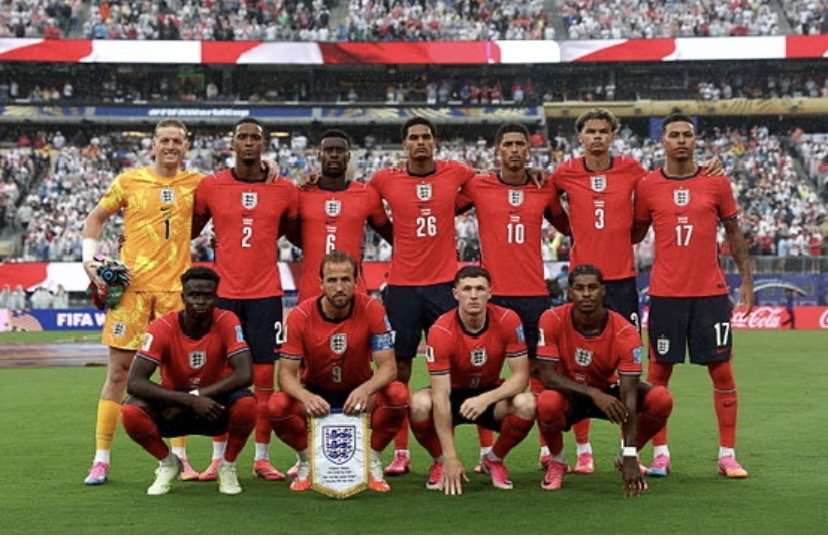
Despite their heroics, the supercomputer remains cautious. England’s projected route to the final is extremely difficult, beginning with a quarter-final against Norway a side inspired by Erling Haaland and fresh off a stunning upset victory over Brazil. Should England progress, even tougher challenges could await against Europe’s traditional heavyweights.
Interestingly, the model’s confidence has shifted dramatically throughout the tournament. Spain started as the favorite before a ball was kicked, but France’s consistent performances have steadily pushed Didier Deschamps’ men to the top of the rankings. Argentina remain dangerous, while surprise packages such as Morocco and Norway have dramatically improved their odds thanks to unexpected knockout victories.
Of course, football has never been played on spreadsheets.
Supercomputers analyze millions of data points, including team strength, player ratings, historical results, expected goals, and thousands of simulated matches. They estimate probabilities not certainties. Every simulation still leaves room for extraordinary moments that statistics simply cannot predict.
England supporters know that better than anyone. For decades, expectations have often ended in heartbreak. Yet this current squad appears different. Under Tuchel, England have shown resilience, tactical flexibility, and an ability to survive high-pressure knockout matches that previous generations often failed to navigate.
That is why many fans believe the supercomputer could still be wrong.
An 8% chance may not sound overwhelming, but it also means England remain among the tournament’s genuine contenders. Every victory increases those odds, and another upset could completely transform the statistical picture overnight.

Whether the Opta model ultimately proves correct or not, one thing is certain: the 2026 World Cup has become one of the most unpredictable tournaments in recent memory. Favorites have fallen, underdogs have emerged, and every knockout match has delivered fresh drama.
If England continue producing performances like their unforgettable victory over Mexico, they may yet achieve something no algorithm can fully capture the belief that football’s greatest stories are written on the pitch, not inside a computer.


 newzechoblog


 Ejima hassan