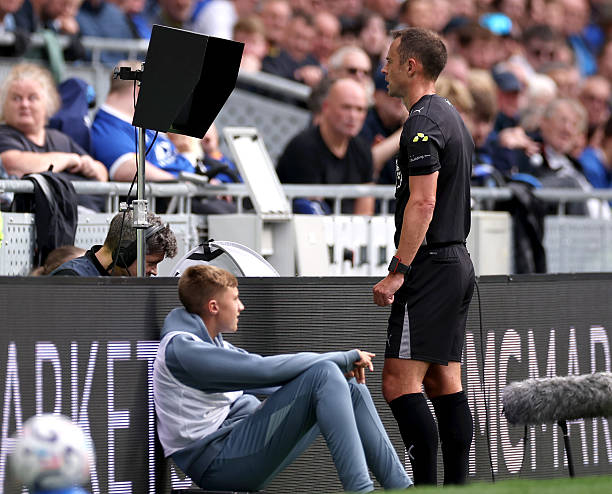
Everton’s hard-fought 1-0 victory over Ipswich Town has been overshadowed by another major VAR controversy after Thierno Barry’s second goal was ruled out following a lengthy review.
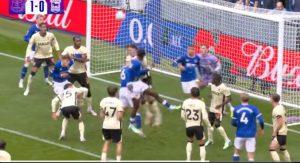
The Toffees secured all three points at the Hill Dickinson Stadium on Saturday, with Barry scoring Everton’s only goal of the afternoon. However, the victory could have been considerably more comfortable had his second-half header been allowed to stand.
Barry appeared to have doubled Everton’s advantage shortly before the hour mark when he met Kiernan Dewsbury-Hall’s corner with a glancing header that found the far corner of the net.
Celebrations followed, but they were abruptly cut short when VAR intervened.
Referee Stuart Attwell was advised to review the incident at the pitchside monitor after VAR officials concluded that Everton forward Brennan Johnson had been in an offside position and had interfered with Ipswich goalkeeper Christian Walton.
Attwell subsequently overturned the goal.
The decision immediately became the major talking point of the match, particularly because Johnson was not close to the ball when Barry made contact with the corner. Sky Sports reported that the VAR decision was based on Johnson being judged to have interfered with Walton’s line of sight.
What has intensified the debate is the available replay footage.
Johnson was positioned in front of Walton, but the ball travelled towards the opposite side of the goal, raising questions over whether his position actually prevented the goalkeeper from making an attempt to save Barry’s header.
One report described the goalkeeper as being positioned on the opposite side of the goal from where the ball entered, while another noted that Walton did not appear to protest the decision.
That has left Everton supporters questioning the threshold being used to determine what constitutes interference.
Under the Laws of the Game, an offside-positioned player can be penalised if they clearly obstruct an opponent’s line of vision or otherwise interfere with an opponent. VAR can recommend an on-field review when there is a potential clear and obvious error in a goal or no-goal decision, but the final decision remains with the referee.
The controversy is particularly significant because English refereeing has already been under intense scrutiny in recent weeks.
The latest incident comes only days after another highly debated VAR decision in the Manchester derby prompted a review and public scrutiny of the officiating process.
For Everton, the controversy did not ultimately cost them points.
Barry’s earlier goal in the 11th minute proved decisive. James Tarkowski’s long-range effort struck Barry and wrong-footed Walton, giving Everton the lead. The Toffees then held on to secure a second league victory of the season and extend their unbeaten start.
David Moyes’ side also had other opportunities to put the match beyond Ipswich, but they were unable to add another legitimate goal.
Ipswich were reduced to ten men when Abdul Fatawu received a second yellow card for simulation in the 67th minute, making Everton’s failure to score again even more frustrating.
Despite the controversy, Everton’s defensive resilience ultimately secured the result. Jordan Pickford made important saves, while Everton’s backline dealt with Ipswich’s late pressure to preserve the clean sheet.
However, the argument surrounding Barry’s disallowed goal is unlikely to disappear quickly.
The central question is simple: did Brennan Johnson’s offside position genuinely interfere with Christian Walton’s ability to save the header?
Those defending the decision can point to the Laws of the Game, which allow a goal to be disallowed when an offside player clearly obstructs an opponent’s line of vision.
Those questioning the decision argue that the goalkeeper appeared to have a clear enough view and that the ball travelled away from Johnson’s position.
That difference in interpretation is precisely why VAR continues to generate heated debate.
Everton may have walked away with the points, but the controversy has once again placed the spotlight on the officials and the increasingly fine margins being used to determine whether goals should stand.
For supporters, the frustration is not simply about one disallowed goal. It is about consistency.
If similar incidents are interpreted differently from one match to another, questions over VAR’s application will inevitably continue.
For now, the official outcome remains unchanged: Everton 1-0 Ipswich.
But the debate surrounding Thierno Barry’s disallowed second goal is only beginning.

And Everton fans will undoubtedly be asking one question:
Was this another case of VAR getting the decision right, or did technology turn a perfectly good goal into another officiating controversy?